
Product docs
Exam-Specific Question Types Tutorial
How Exam-Specific Questions work
Preparing for exams isn't just about reviewing content — it's about practicing the right questions in the right format.
The Exam-Specific Questions feature bridges that gap by transforming your study materials into targeted questions that mirror real exam experiences. Instead of relying on generic practice, this feature lets you generate questions aligned with specific exams — such as MCAT, NBOME, NBME, and AP — so you can practice with questions that match your actual exam's format and complexity.
Accessing Exam-Specific Question Types
Exam-Specific Question Types are available whenever you create a QuizFetch quiz or a Practice Test. Both flows share the same question-type selection step described below.
-
Start creating a quiz or test as usual. On the question-type selection step, scroll down to Exam-Specific Question Types and click Show.

Create Quiz, step 3 of 4: How many questions of each type? The reader clicks Show to open Exam-Specific Question Types. -
Four top-level exam categories appear: Medicine & Healthcare, Finance, Law School, and AP Exams.
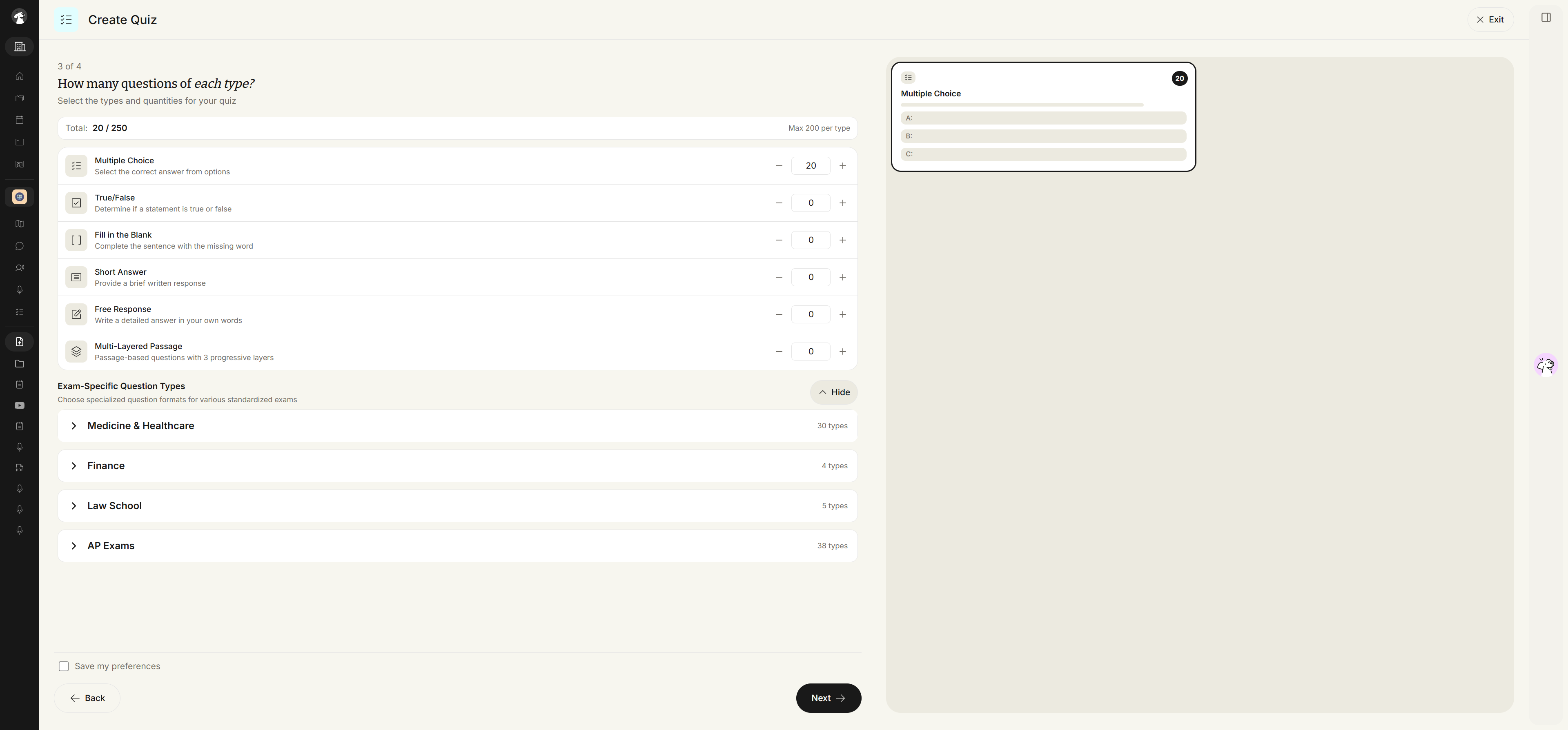
Create Quiz, Exam-Specific Question Types expanded. The reader picks Medicine & Healthcare, Finance, Law School, or AP Exams.
Medicine & Healthcare
Click Medicine & Healthcare to expand its specialties: Med School, Nursing, Physician Assistant, Dentistry, Optometry School, Podiatry School, Respiratory Therapy, Pharmacy, Physical Therapy, and Emergency Medical Services.

Med School
Expanding Med School reveals its own subcategories: Pre-Med, D.O. (Osteopathic) NBOME Exams, and M.D. (Allopathic) NBME Exams.

Pre-Med
Select Medicine & Healthcare → Med School → Pre-Med to see the two available question types, each with an Examples link.

Create Quiz, Pre-Med expanded. Its question types are MCAT discrete (Stand Alone) Questions and MCAT Passage-Based Questions, each with an Examples link.
- MCAT discrete (Stand Alone) Questions — Passage-based questions testing integration of natural sciences, research methods, and critical analysis. Focus on data interpretation and application of scientific concepts to biological systems and research scenarios.
- MCAT Passage-Based Questions — Research-based passages with progressive questions: Recognition (identify the concept or phenomenon), Mechanism (explain the scientific basis), and Application (apply to new scenarios or predict outcomes).
Click Examples next to a question type to preview sample questions before adding them to your quiz.
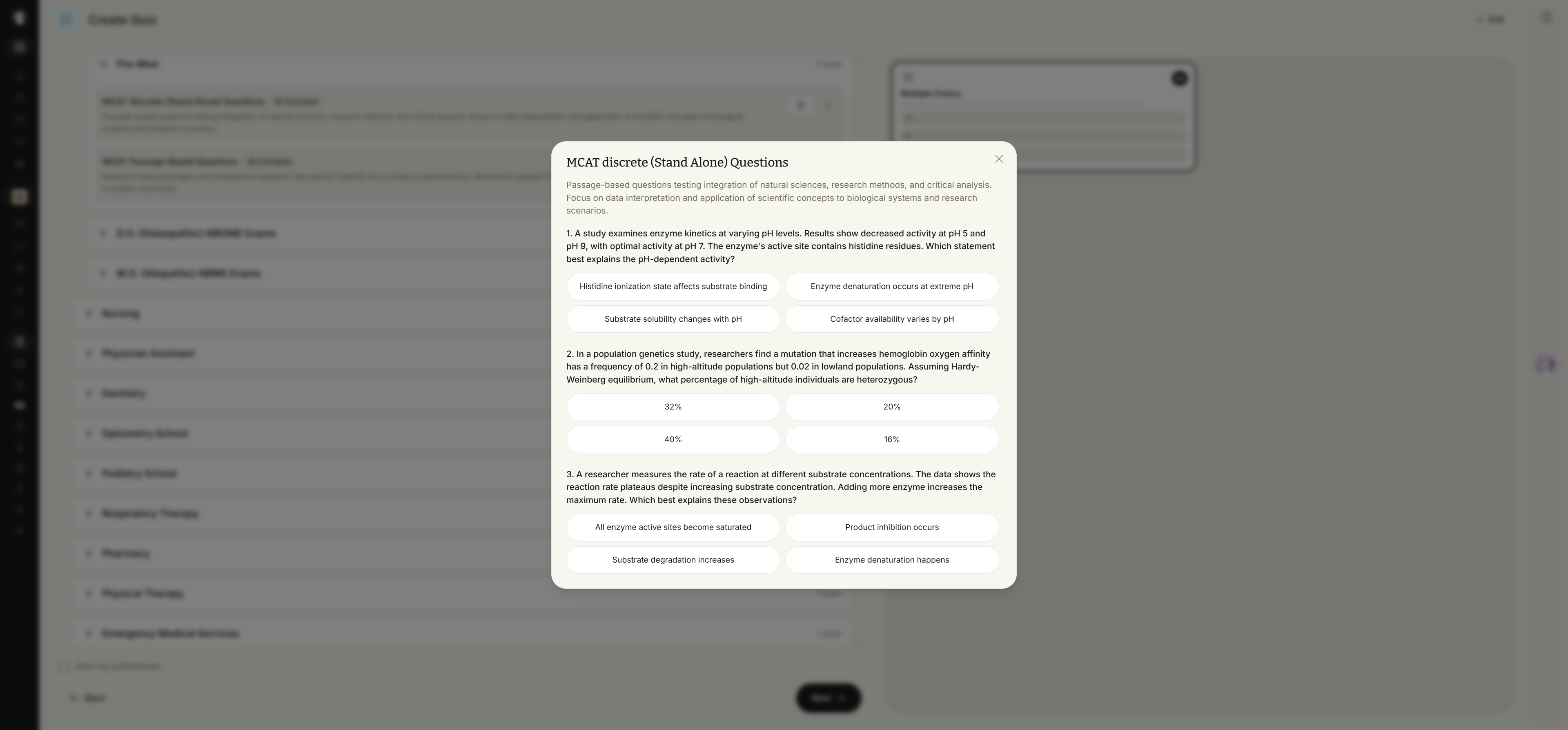
MCAT discrete (Stand Alone) Questions, examples. The reader reads three sample questions with their answer choices. Use the + and − controls to set how many questions of that type to generate, same as any other question type.
D.O. (Osteopathic) NBOME Exams
- COMLEX Level 1 Style — Clinical vignette-based questions testing basic science mechanisms, pathophysiology, pharmacology, and osteopathic principles. Focus on integrating foundational medical concepts with osteopathic manipulative medicine (OMM) principles.
- COMLEX Level 2 Cognitive Evaluation Style — Patient-centered scenarios testing clinical knowledge, diagnosis, management, and osteopathic considerations. Focus on integrating OMM into comprehensive patient care and evidence-based clinical decision-making.
- COMLEX Level 3 Style — Complex clinical scenarios testing readiness for independent osteopathic practice. Focus on patient management over time, integrating OMM into comprehensive care plans, and demonstrating osteopathic philosophy in practice.
- COMAT FBS Style — Pre-clinical assessment covering foundational biomedical sciences with osteopathic integration. Tests basic science knowledge across body systems and disciplines including biochemistry, anatomy, microbiology, physiology, pharmacology, and neurosciences.
- COMAT Clinical Subject Exam Style — End-of-rotation clinical assessments integrating osteopathic principles with specialty knowledge. Tests clinical diagnosis, management, diagnostic interpretation, and application of osteopathic manipulative medicine across clinical disciplines.