Skip to content
StudyFetch Academy

Product docs

Create a Practice Test

Introduction

The Test feature allows you to create customized practice tests based on your study materials. These tests help you assess your knowledge, identify areas that need improvement, and prepare for upcoming exams with personalized questions.

Accessing the Test Feature

On the left-hand side of your Dashboard, click Practice and then select Test. All existing practice tests for your Study Set live here — click any of them to open it, or start a new one below.
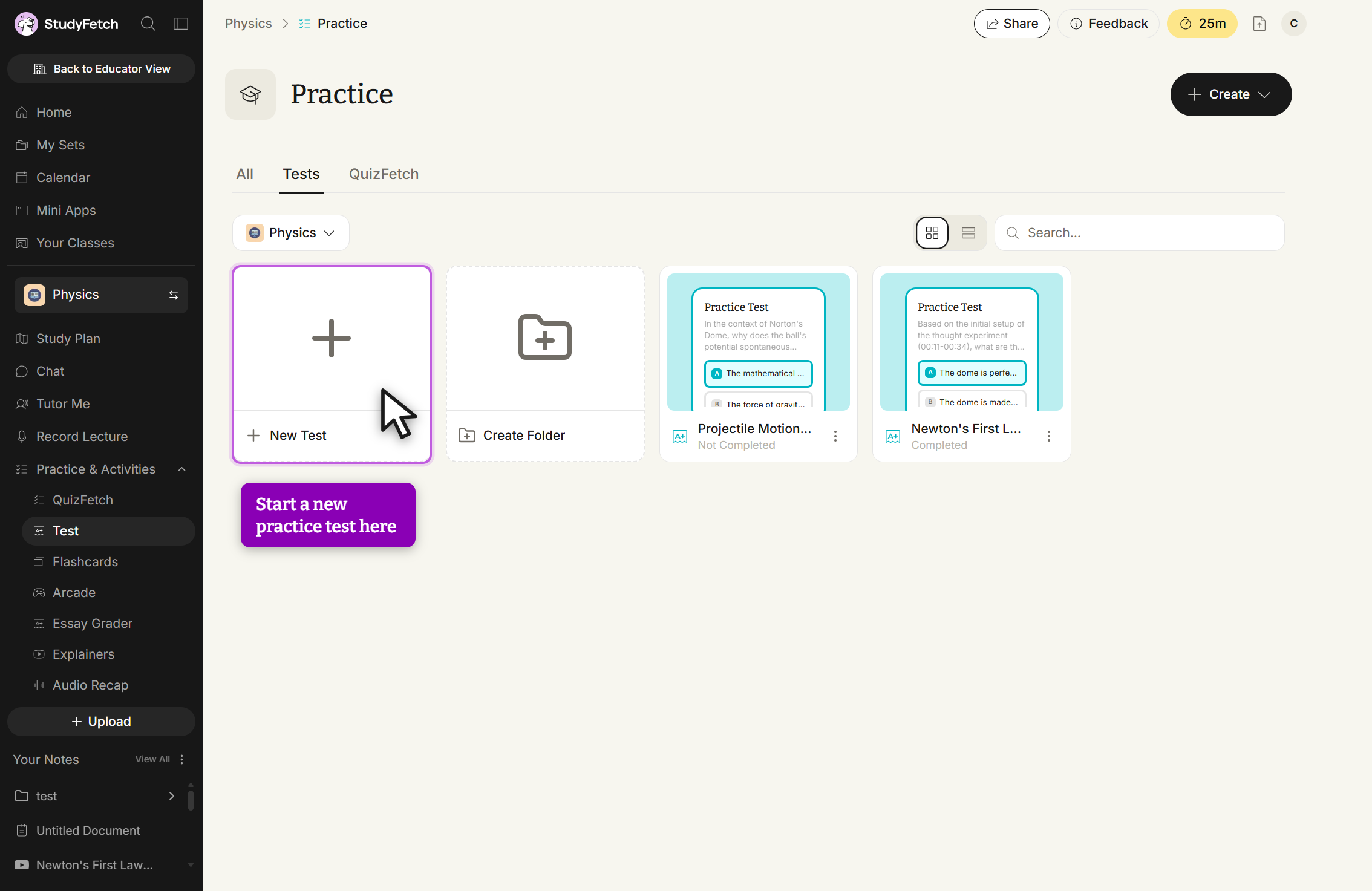
The Practice page in StudyFetch with the Tests tab selected for the Physics set. The grid shows a + New Test tile, a Create Folder tile, and two existing tests: Projectile Motion, marked Not Completed, and Newton's First L..., marked Completed. In the left sidebar, Practice & Activities is expanded with Test selected.
Practice, Tests tab. The + New Test tile sits alongside Create Folder and the tests already in this set.

Creating Your Test

Select + New Test to open the Create Practice Test flow, a guided 4-step wizard.

Step 1: Choose your source

Choose Create from Materials to build a test from your study materials, or Create from Flashcards to generate one from an existing flashcard set.
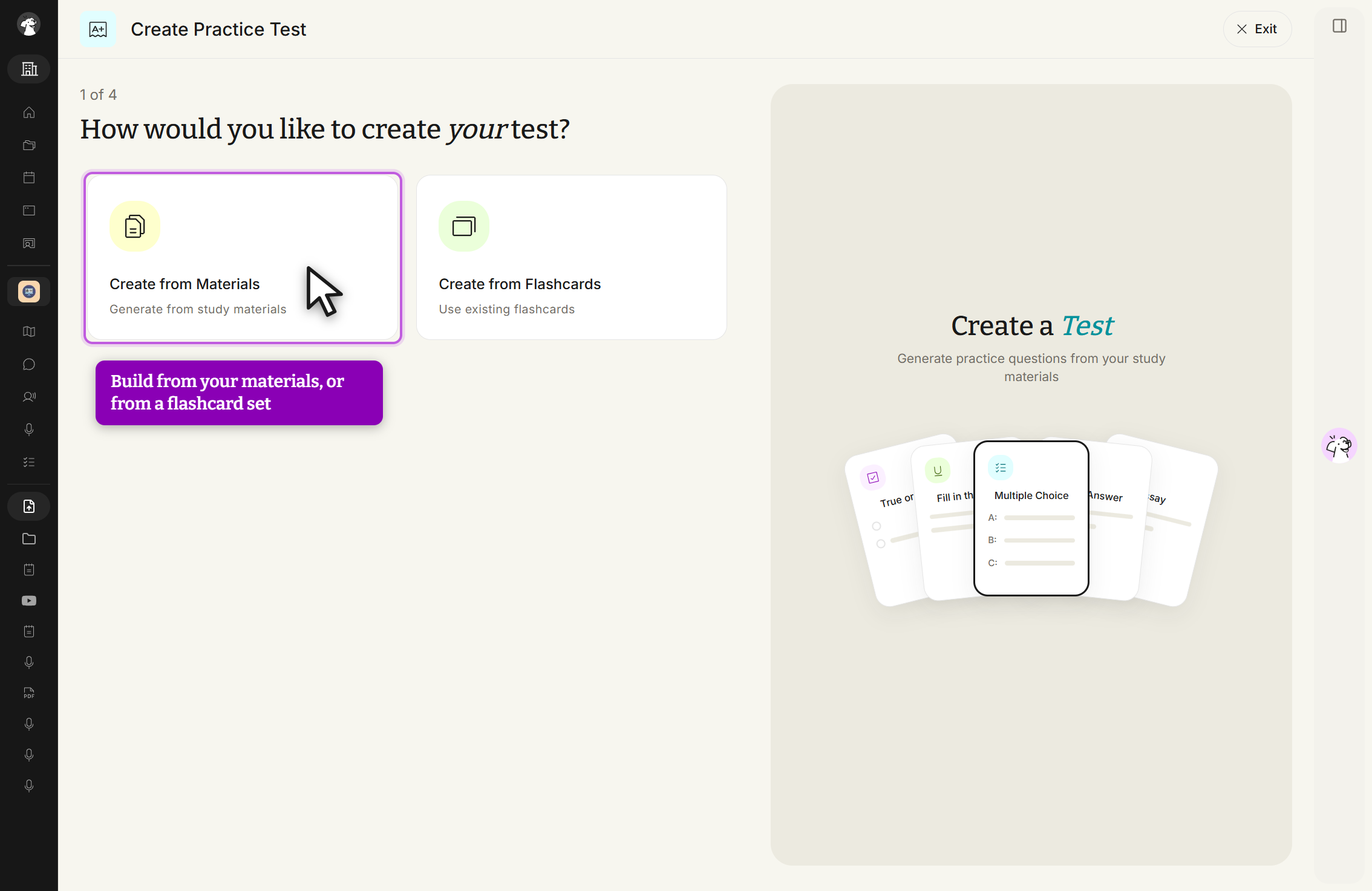
The Create Practice Test screen labeled 1 of 4, headed How would you like to create your test? Two cards are offered: Create from Materials, Generate from study materials, and Create from Flashcards, Use existing flashcards. An Exit button sits in the top right.
Create Practice Test, 1 of 4. Choose Create from Materials or Create from Flashcards.

Step 2: Select your materials

Choose which uploaded materials to generate questions from, or select + Upload New Material to add something new, then click Next.
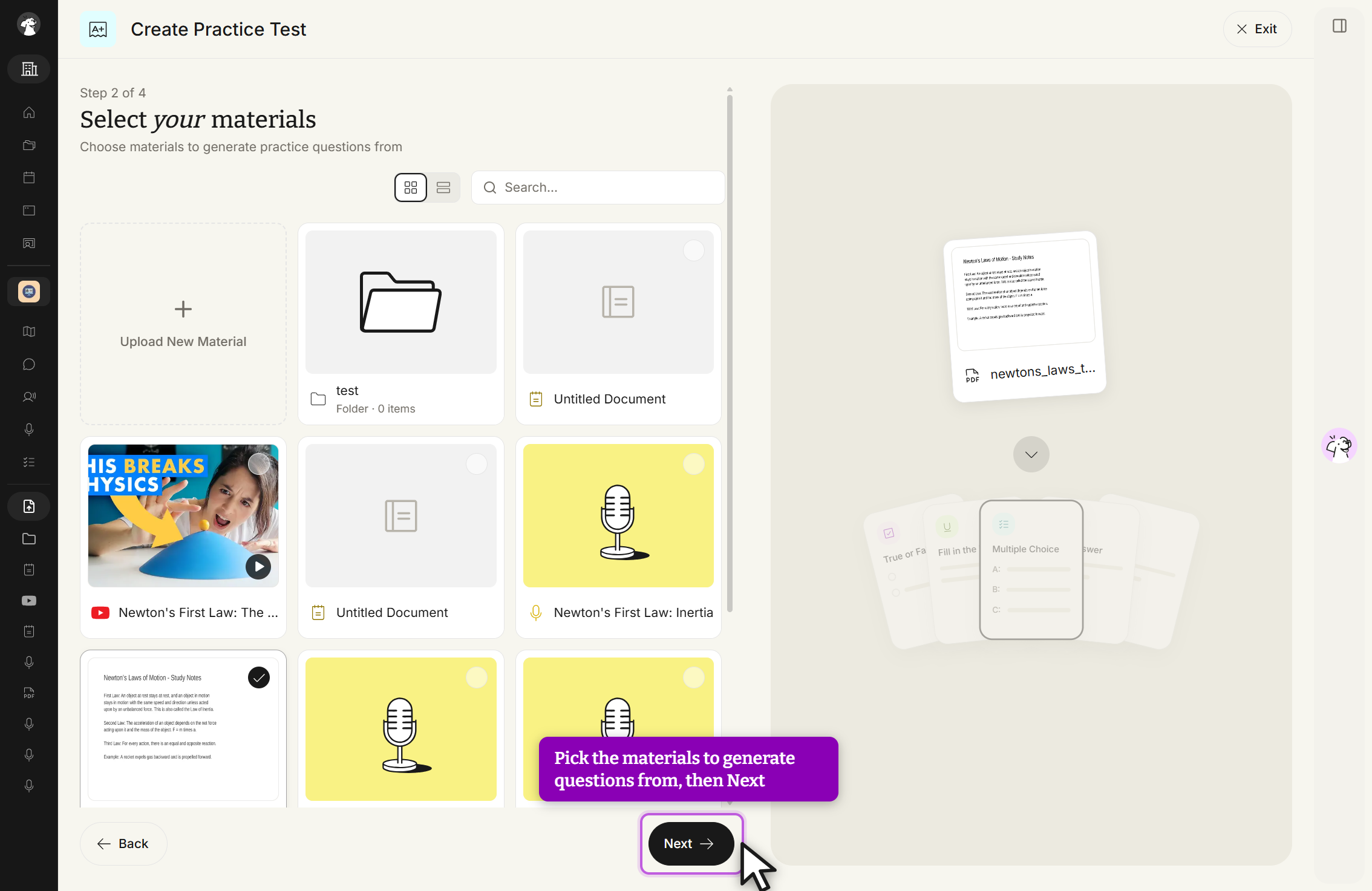
The Create Practice Test screen at Step 2 of 4, Select your materials, with the subtitle Choose materials to generate practice questions from. The grid holds an Upload New Material tile plus a test folder, two Untitled Document items, a Newton's First Law video, two audio recordings, and a Newton's Laws of Motion study-notes document that is checked. Back and Next buttons sit at the bottom.
Create Practice Test, Step 2 of 4. Tick the materials the questions come from, then click Next.

Step 3: Choose your question types

Set the number of questions for each format — Multiple Choice, True/False, Fill in the Blank, Short Answer, Free Response, and Multi-Layered Passage — using the +/- controls or the quick preset buttons (-10/-5/-1/+1/+5/+10). A live preview of your question cards builds on the right as you go.
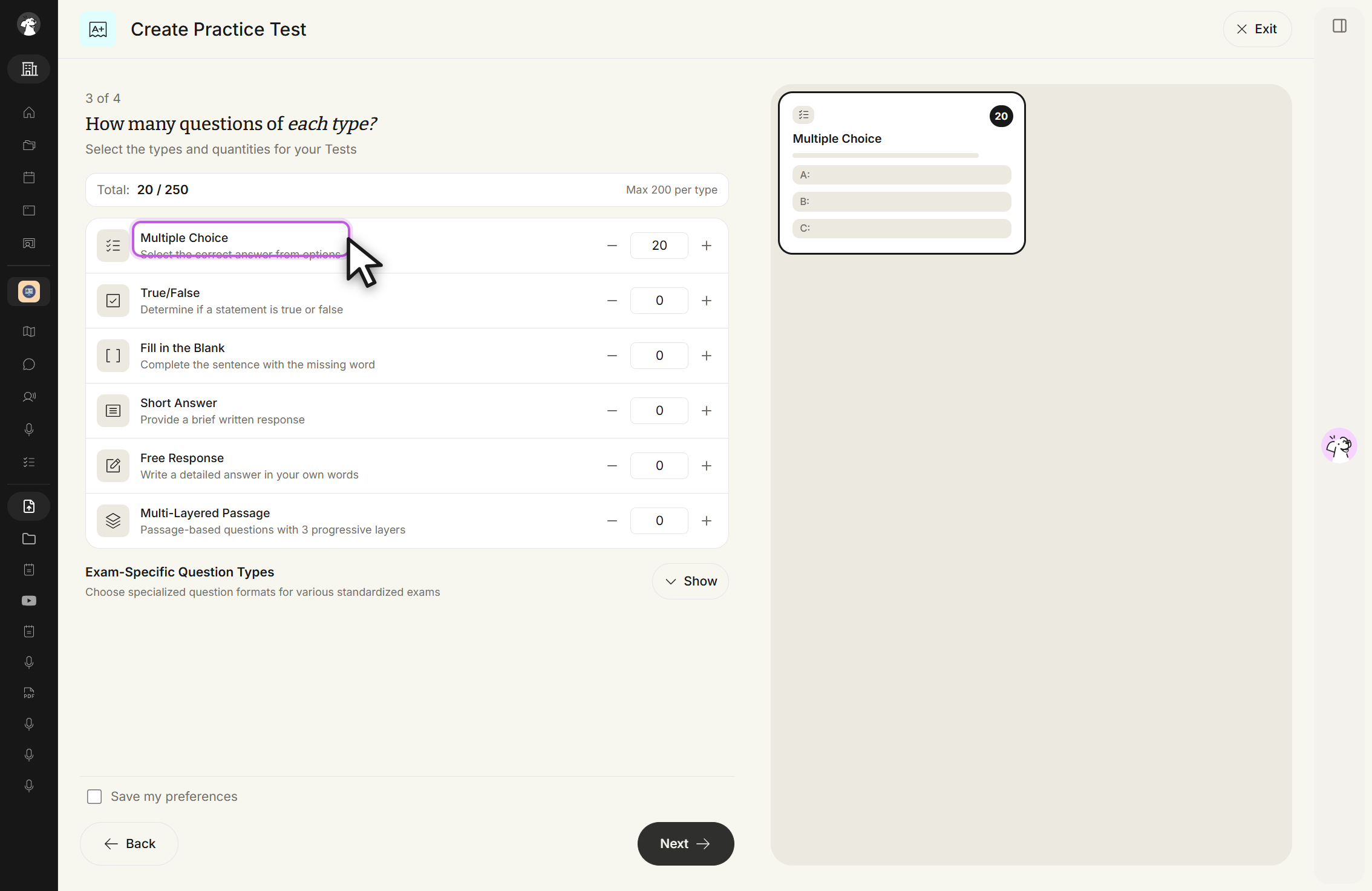
The Create Practice Test screen labeled 3 of 4, headed How many questions of each type? Total reads 20 / 250 with Max 200 per type. Multiple Choice is set to 20; True/False, Fill in the Blank, Short Answer, Free Response, and Multi-Layered Passage are each set to 0. Every row has a minus button, a number field, and a plus button. Below sit an Exam-Specific Question Types section with a Show button, a Save my preferences checkbox, and Back and Next buttons. One preview card on the right reads Multiple Choice with a count of 20.
Create Practice Test, 3 of 4. Set a count for each question type with the minus and plus buttons.

An Exam-Specific Question Types section sits below the standard types, collapsed by default. Expand it to generate questions formatted for a specific standardized exam (Medicine & Healthcare, Finance, Law School, AP Exams, and more).
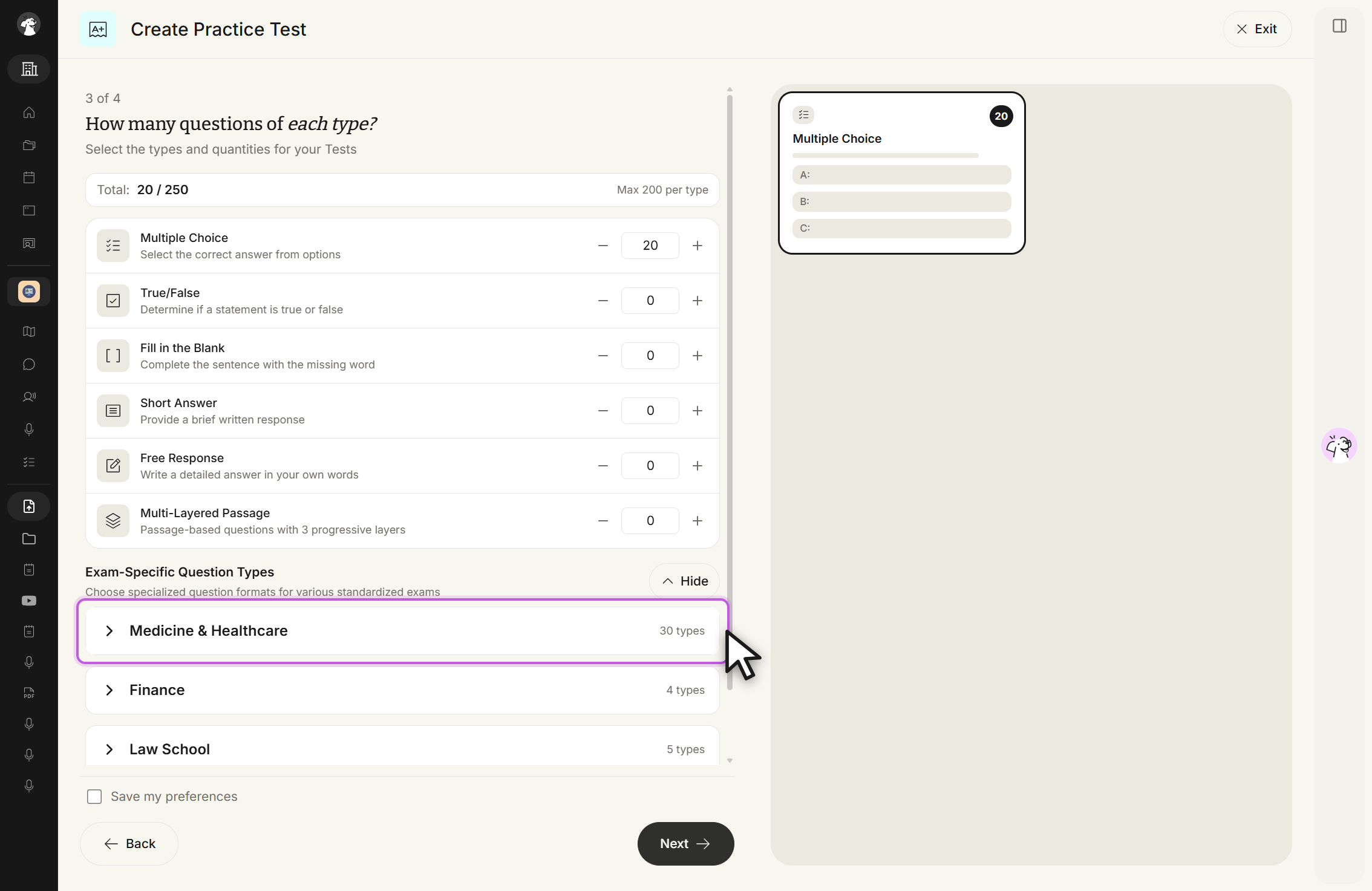
The Create Practice Test screen at 3 of 4 with the Exam-Specific Question Types section opened, its toggle now reading Hide. Three collapsed category rows are visible: Medicine & Healthcare, 30 types; Finance, 4 types; and Law School, 5 types. The list continues below the visible area.
Create Practice Test, 3 of 4 with Exam-Specific Question Types shown. The categories in view are Medicine & Healthcare, Finance, and Law School.

For more details, see Exam-Specific Question Types.

Step 4: Additional settings

Name your test (StudyFetch will name it for you if you leave this blank), choose the test's language, and optionally customize it with a plugin like Summarizer Sparky, Professor Sparky, or Deep Learner Sparky — or select Explore Plugins to browse more or build your own.
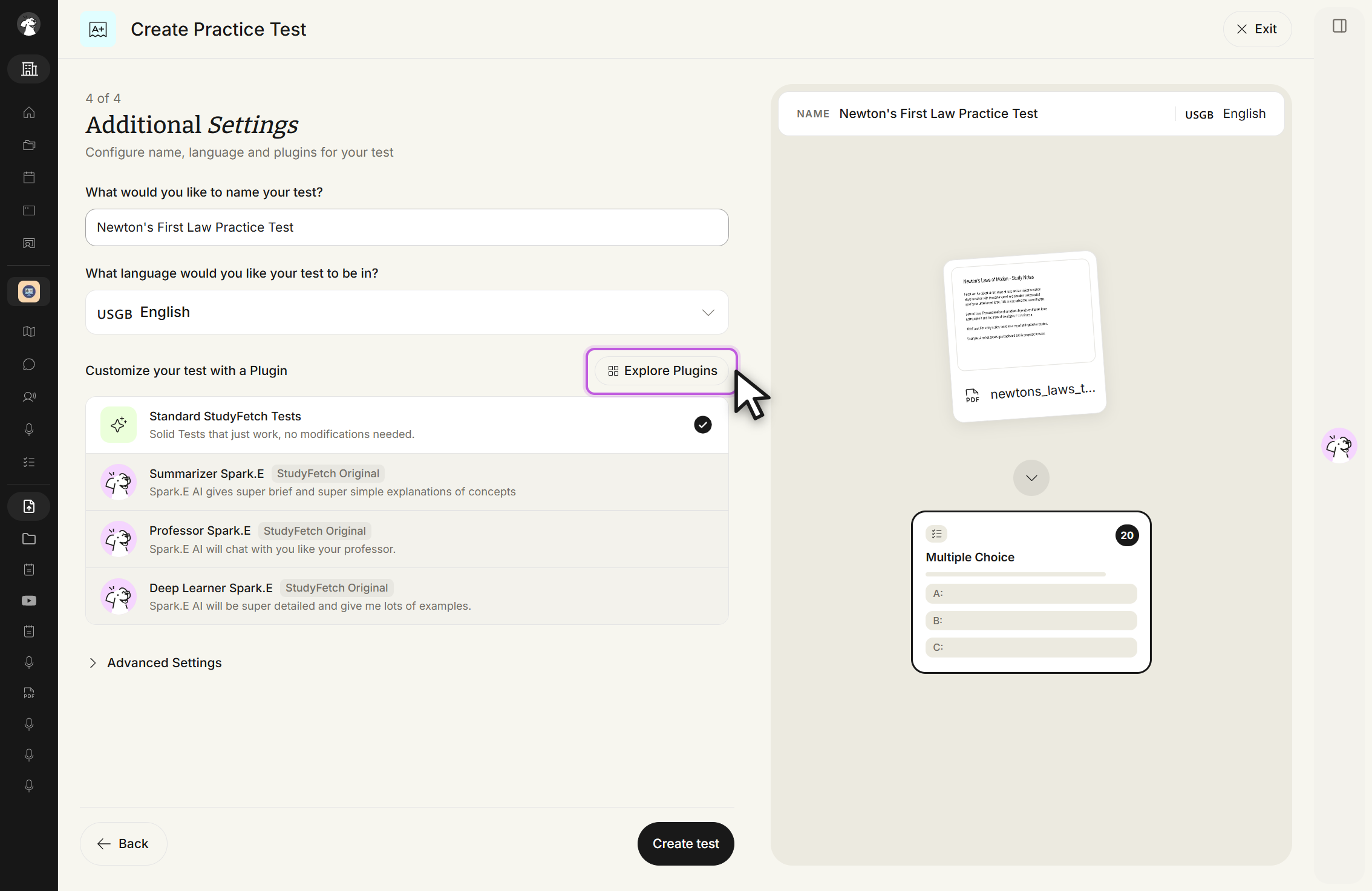
The Create Practice Test screen labeled 4 of 4, Additional Settings, with the subtitle Configure name, language and plugins for your test. The name field contains Newton's First Law Practice Test and the language selector reads English. Under Customize your test with a Plugin, Standard StudyFetch Tests is ticked, with Summarizer Spark.E, Professor Spark.E, and Deep Learner Spark.E listed below it and an Explore Plugins button to the right. A collapsed Advanced Settings row, a Back button, and a Create test button sit at the bottom.
Create Practice Test, 4 of 4. Name the test, pick its language, and choose a plugin.

An Advanced Settings section, also collapsed by default, holds an optional Focus Topic field so you can steer the test toward specific concepts from your materials.
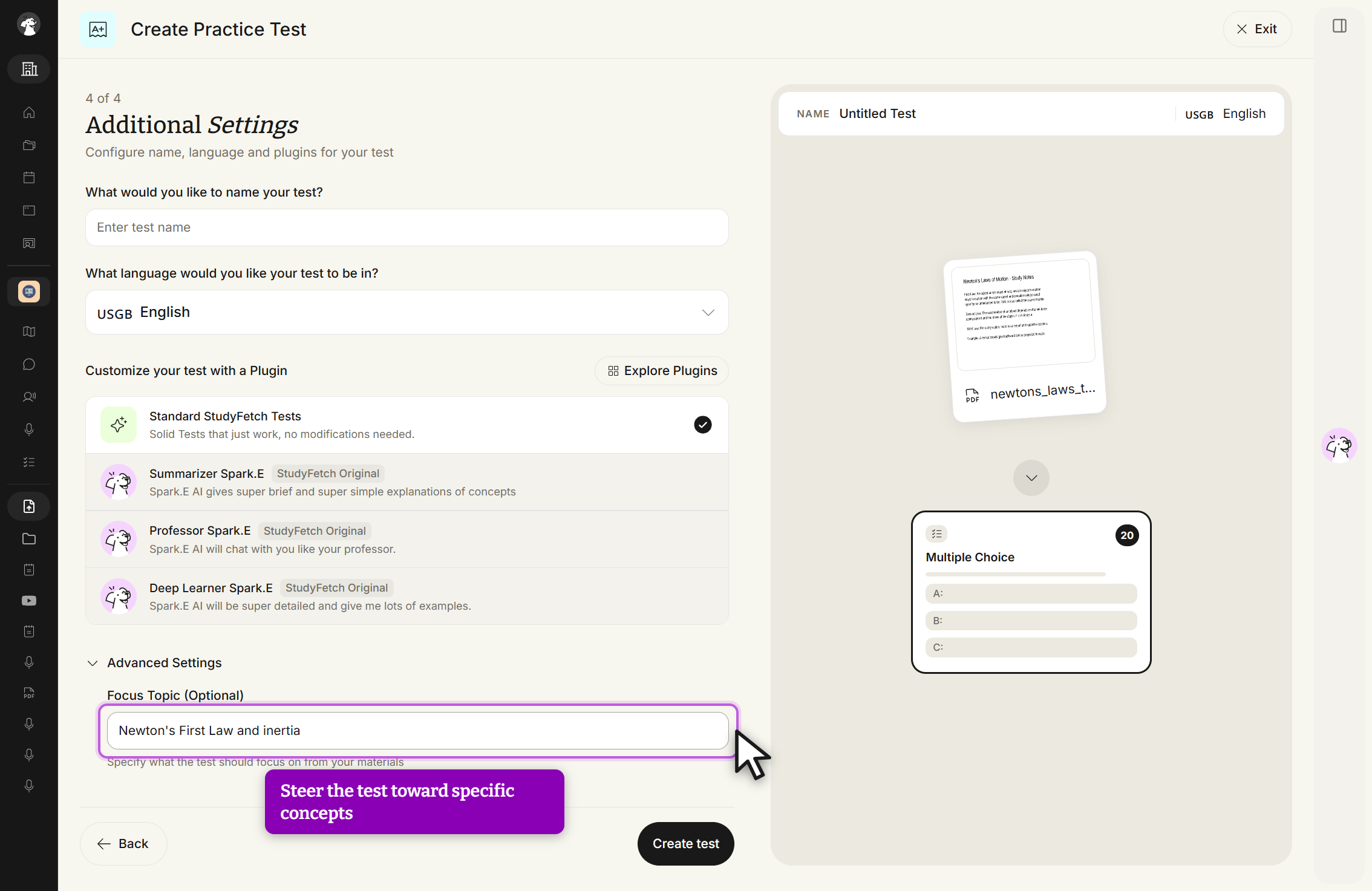
The Create Practice Test screen at 4 of 4, Additional Settings, with Advanced Settings opened. The name field shows only its placeholder, Enter test name, and the preview header reads NAME Untitled Test. The Focus Topic (Optional) field contains Newton's First Law and inertia, with the hint Specify what the test should focus on from your materials. Back and Create test sit at the bottom.
Create Practice Test, 4 of 4 with Advanced Settings opened. The Focus Topic (Optional) field reads Newton's First Law and inertia.

Select Create test and StudyFetch will generate your customized practice test. The first time you open a generated test, a short "Test — Time to Shine" walkthrough introduces the test-taking controls.
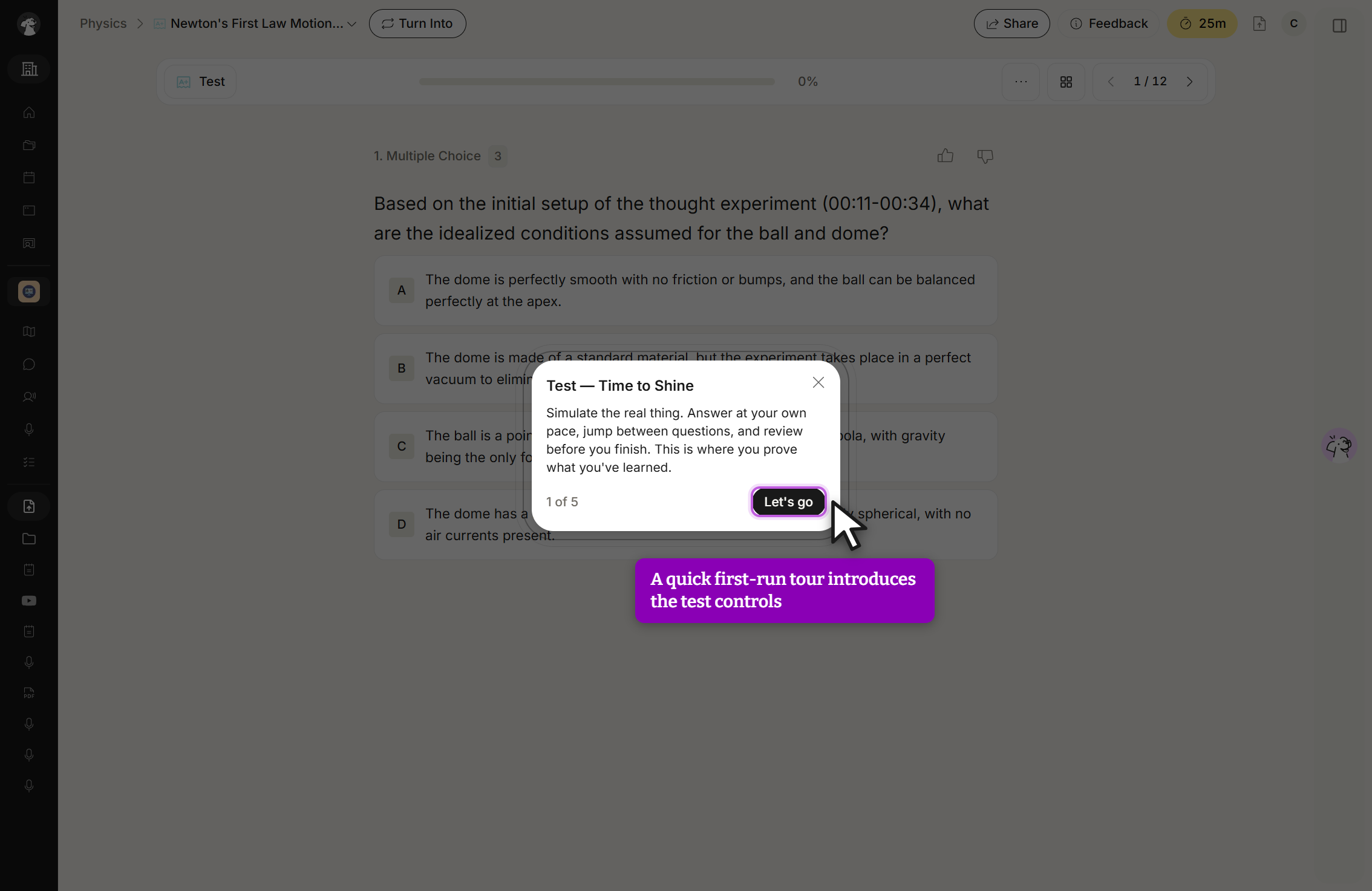
A generated test named Newton's First Law Motion open at question 1 / 12, a Multiple Choice question worth 3 points about the thought experiment at 00:11-00:34, with options A through D and progress at 0%. A first-run dialog titled Test, Time to Shine sits over the page, reading 1 of 5 with a Let's go button and a close X.
Test, Time to Shine dialog, 1 of 5. Select Let's go to start the walkthrough of the test controls.